
The Transaction Is Becoming Regulatory Infrastructure
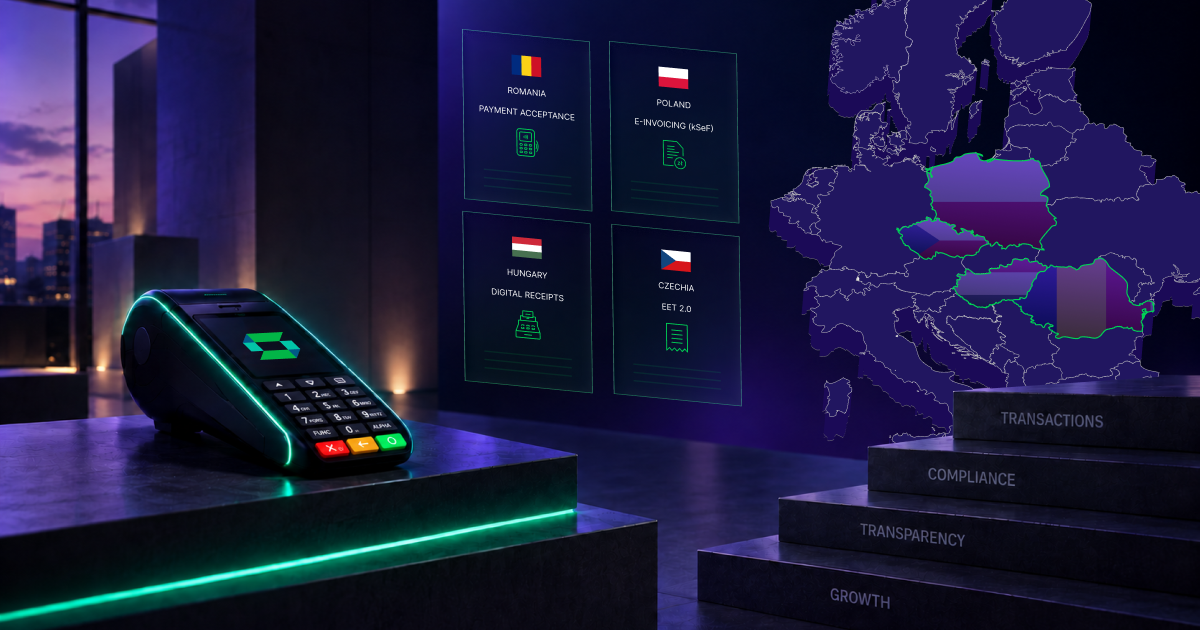
For an enterprise merchant operating across Central and Eastern Europe, a regulatory change in one market rarely stays within the compliance team. It can affect how transactions are captured, how receipts or invoices are generated, how systems exchange data and how commercial activity is reconciled and reported.
That challenge is becoming more visible across the region.
Romania has broadened electronic payment acceptance requirements. Poland is implementing mandatory electronic invoicing through KSeF in phases. Hungary has extended receipt data reporting requirements. In Czechia, EET 2.0 is intended to introduce a modernised transaction registration system from January 2027, subject to completion of the legislative process.
These are not four versions of the same regulation. They apply to different parts of the transaction and reporting environment and create different obligations for businesses.
However, they point in the same direction.
Transaction data is becoming more structured, more visible and more closely connected to the systems businesses use to record, reconcile and demonstrate compliance.
For enterprise merchants, this raises a broader infrastructure question.
A local regulation can create a regional infrastructure problem
A new requirement may begin as a country-specific compliance project. Its impact can extend across payment terminals, cash registers, invoicing platforms, acquiring relationships, reconciliation processes and reporting systems.
For businesses operating across several markets, the challenge becomes greater when these connections have been built separately for each country, channel or provider.
Regulatory change can then trigger additional integration work across an already fragmented environment. Local teams need to respond to market-specific requirements, while central teams still need visibility and control across the wider payment estate.
For a merchant operating hundreds of locations across several CEE markets, this can mean duplicated work, additional system dependencies and higher change costs. Regional expansion can also become more complex when every new market introduces another combination of payment, fiscal and reporting systems to manage.
The strategic question is therefore not only whether the business can meet the next deadline.
It is whether its infrastructure can absorb new requirements without adding another layer of complexity.
Payment infrastructure must become easier to adapt
Enterprise payment infrastructure must still deliver fast and reliable acceptance. That is the starting point.
But reliability alone does not address the complexity of operating across multiple markets, channels and acquiring relationships.
Central teams need consistent visibility across stores, digital channels, terminals and transactions. Local operations need enough flexibility to support different payment methods, fiscal systems and regulatory requirements.
This does not mean that a payment platform replaces invoicing, fiscal reporting or tax compliance systems.
It means the payment layer should be able to connect with those systems without requiring the merchant to redesign its entire payments estate whenever a local requirement affects the transaction environment.
This is where payment orchestration becomes relevant.
Rather than building separate payment connections around every channel, acquirer or market, orchestration can provide a common layer between payment channels, acquiring partners and the systems already running the business.
The objective is not to standardise every local obligation. It is to make the payment infrastructure underneath those obligations more consistent and easier to adapt.
Building a consistent payment layer across markets
Symphopay ONE provides enterprise merchants with a central environment for payment orchestration, transaction visibility, real-time reporting and terminal management.
It connects in-store, e-commerce, mobile and QR payments and can integrate with existing POS and cash-register software. This gives merchants a way to modernise the payment layer while continuing to work with the systems and acquiring relationships already supporting their operations.
At enterprise scale, the ability to introduce infrastructure changes without disrupting large merchant networks is particularly important.
Profi, one of Romania's largest retail networks, deployed Symphopay's payment infrastructure across 1,750 stores in six weeks. The deployment demonstrates the ability to implement and centrally manage payment infrastructure across a large physical retail footprint while maintaining the operational control required at enterprise scale.
Read the full Profi case study →
The broader value is not simply the ability to introduce another payment method.
It is having a payment foundation that can evolve with the business, connect with different local systems and support expansion without multiplying infrastructure complexity.
Regulations will continue to differ across CEE. Enterprise merchants may not be able to standardise every local obligation, but they can build a more consistent payment layer underneath them.
As new payment, reporting and fiscal requirements emerge, that distinction matters. The next requirement should not automatically mean rebuilding another part of the payment estate.
Speak with our team about building a payment foundation ready for the next requirement.


